Magic Resistance. Botanical conflicts and Eco-Feminisms
Opening: Friday July 24, start 7 p.m.
with Performances by Wirya Budaghi & Anguezomo Nze Mba Bikoro
Exhibition: July 25, 2026 – August 30, 2026
Curation: Anguezomo Nze Mba Bikoro, muSa michelle mattiuzzi, Andrea Goetzke
Open by appointment:
Open: August 1, 2026 from 3PM – 7PM.
Film Screening: August 28th at 9PM with Denise Ferreira da Silva & Arjuna Neuman
Reading Sessions: August 27th & 28th at 6.30 PM with the curatorial collective
Finissage (Closing Event): Sunday, August 30, 2026, 3:00 PM – 6:00 PM
Inspired by the radical philosophies of Gus Speth, Frantz Fanon, and Sylvia Wynter, this exhibition calls for a profound relational, spiritual and ecological and material transformation, showcasing how communities—historically led by women freedom fighters—re-code cultural memories to resist capitalist extraction and restore planetary solidarity. Grounded in a feminist formulation of social justice, this constellation between Yupanqui Ramos and Milena Bonilla positions ecological care and “plant companionship” as vital modes of territorial defense. Both artists explore how humans and flora together resists colonial control, demonstrating how intersectional care empowers human connection to the soil and activates political resistance.
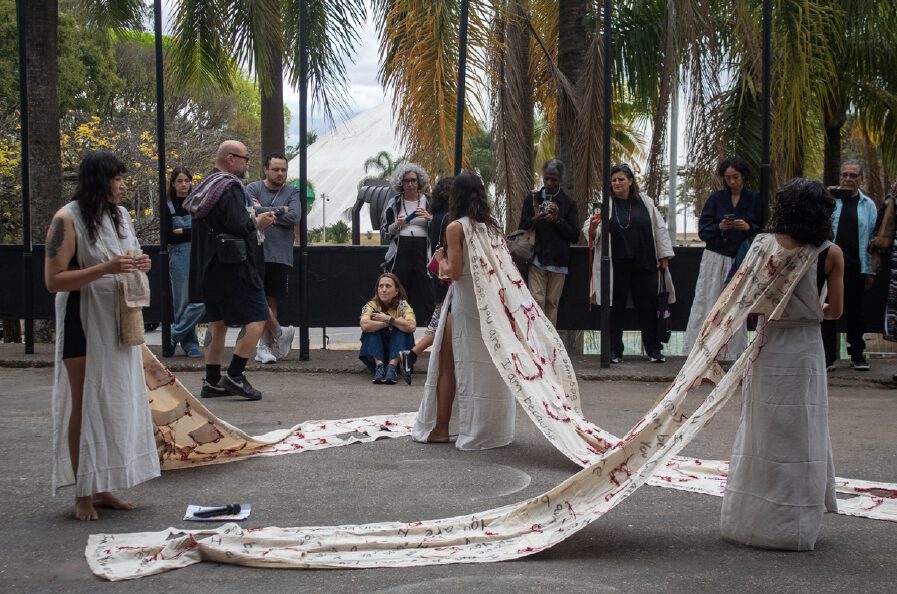
Yupanqui Ramos’ Error 404: soil not found exposes the dangers of corporate GMOs by contrasting them with seed sovereignty and the ancestral Milpa polyculture system. An installation developed from a performance with 3 costumes, that function as active, soil-filled ecosystems, her work navigates tensions between modern CRISPR patents and ancestral commons-based seed rhythms. Drawing from Mayan narratives and Ubuntu, Ramos highlights ecological care as an anticolonial struggle.
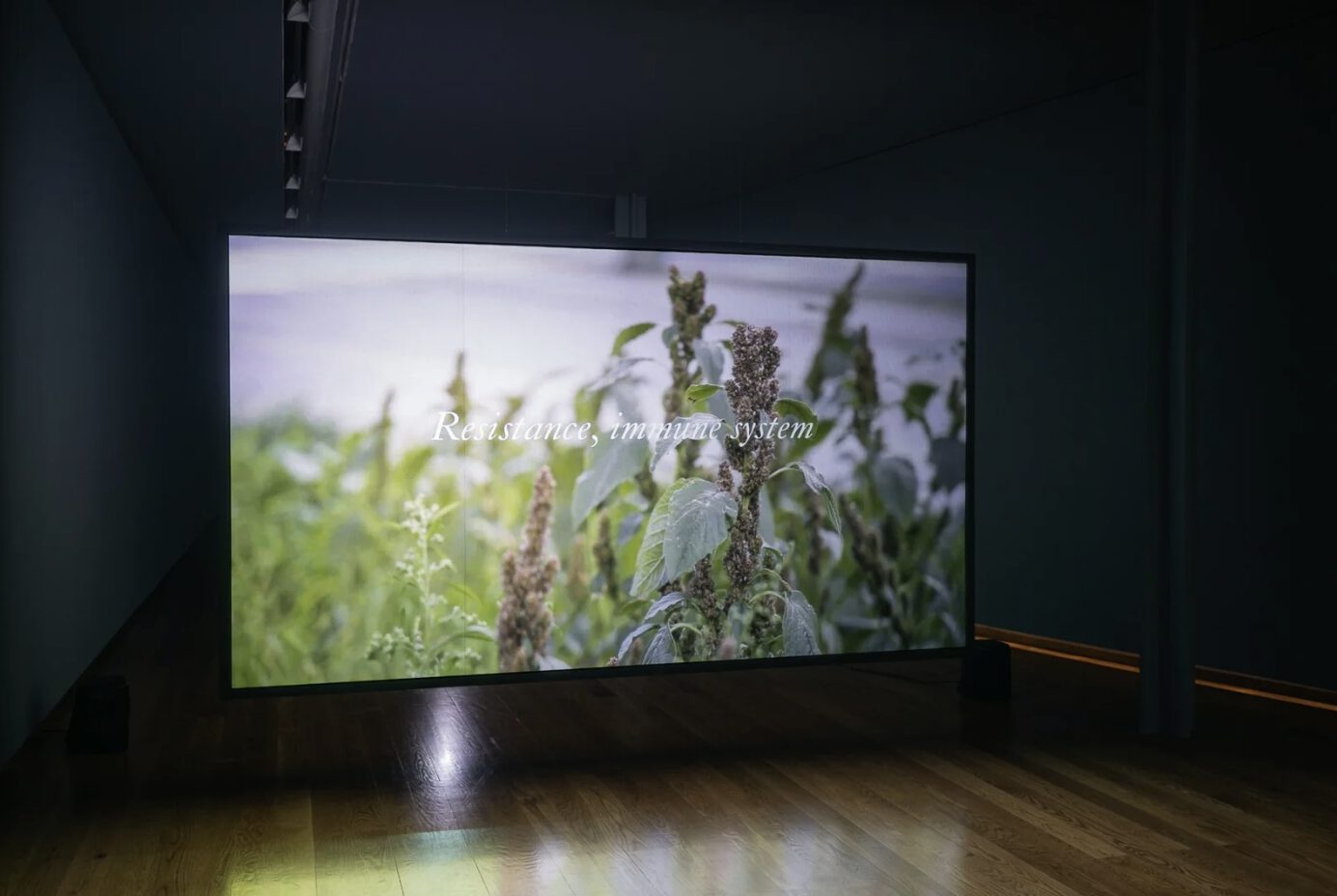
By retracing Rosa Luxemburg’s botanical legacy and her own deep personal connection to plants during her political struggle, Milena Bonilla’s video trilogy, I am life, and life is beautiful (A conversation guided by Rosa Luxemburg’s herbarium with herbalist and dancer Shelley Elkin), uses Luxemburg’s historic herbarium as a unique meeting point to intersect different cultural traditions of plant companionship, ultimately delivering a powerful eco-feminist critique of colonial capitalism.In collaboration with Shelley Etkin, the work weaves somatic movement with historical archive to reframe prison-era botany as a vital tool for survival and resistance. Introducing “plant companionship” as political defiance, Bonilla connects environmental care to decentralized, female-led ecological farming traditions, positioning flora and ecosystems as active participants in planetary liberation.
Ancestral Clouds Ancestral Claims (2023) is an experimental essay film by Denise Ferreira da Silva with Arjuna Neuman that focuses on the element of air. The film follows wind currents into Chile’s Atacama Desert to connect the ruins of colonial labor camps and modern lithium mines with the stars seen through advanced space telescopes. By tracking these atmospheric layers, the artists show how modern technology is physically linked to historical violence. Ultimately, the filmmakers employ the wind as a narrative framework to challenge Western paradigms of progress, prompting the audience to recognize the Earth as an active site of resistance that witnesses, archives, feels and responds to the historical violence of colonial exploitation.
Through feminist ecological resistance and body-centered healing, Wirya Budaghi and Anguezomo Nze Mba Bikoro performances for the opening, position the earth as an active participant in human liberation, showcasing how anti-colonial land defense and communal practices, from Kurdish eco-villages to Amazigh-inspired sonic therapy, are essential for overcoming state and patriarchal violence.
The reading sessions take up texts of decolonial and Black emancipatory theory, eco-feminist approaches, environmental justice and historical and current examples of human-plant comradeship in resistance struggles connected to the curatorial frame and research interests for the exhibition.
The artists’ works will be expanded alongside reading sessions exploring authors such as Denise Ferreira da Silva, Olúfẹ́mi O. Táíwò, Sylvia Wynter, Silvia Federici, Ros Gray & Sheila Sheikh and Rosa Luxemburg, aiming to re-examine reparations for colonial forensic crimes through the lenses of agricultural exploitation, eco-feminist movements, environmental racism and queer ecologies.
BIOGRAPHIES:
MILENA BONILLA (b. Bogotá)is a visual artist, educator and independent researcher, living and working in Amsterdam. She is interested in practices and knowledge that propose and place particular questions about language and agency as ontological properties exclusive to humans, and how this precept is embedded in the way in which economic policies under capitalism operate. This perspective is informed by research on epistemic diversity and its colonial conditioning, as well as by notions on art as medicine. Recent exhibitions include the Baltic Gallery of Contemporary Art BGSW, Slupsk, Poland; CCA Ujazdowski Castle, Warsaw; Framer Framed, Amsterdam, Galeria Municipal do Porto; The School of Impatiences, Normandy; Temporary Gallery, Cologne, and the Museum Miguel Angel Urrutia MAMU, Bogotá, among others. Recent teaching and advisory includes the Oslo Academy of Arts; Sandberg Institute, Amsterdam, and WdKA Rotterdam. Milena is currently collaborating with If I Can’t Dance I Don’t Want To Be Part of your Revolution -Amsterdam, in the long term project “Ferals and Ruderals, History from the Cracks”.
https://milenabonilla.info
YUPANQUI RAMOS (b. León, Guanajuato, Mexico) (she/her) is a multidisciplinary artist and costume designer whose work bridges installation and performance art. Her practice critically examines colonial dynamics within environmental contexts, intertwining folk storytelling to forge new connections between the human and the morethan-human worlds. Through her immersive installations and evocative performances, Ramos invites audiences to question and reimagine the intricate relationships between culture, nature, and identity. Her work often incorporates traditional craft techniques and contemporary artistic forms, creating a dialogue that transcends temporal and cultural boundaries. Ramos has presented her work at notable venues and events, including 36th Biennale Sao Paolo, Sophiensaele (2025) Humboldt Forum, Berlin (2024), Thalía Theater (2023), Kampnagel, Hamburg, (2022), and Beaux Arts Paris, France (2020).
www.yupanquiramos.com
WIRYA BUDAGHI (b. 1979) is a Kurdish-Iranian performance artist and activist who holds a master’s degree from the University of Art, Berlin. After fleeing persecution from the Iranian Revolutionary Guard in both Iran and Iraq, he spent time in German refugee camps before establishing his international art career. His powerful performance art uses his own body to challenge state violence, military attacks, and racial exclusion while fighting for human rights and the right to his mother tongue. Through his highly acclaimed work, which has been featured in galleries and festivals across Iraq, the United Kingdom, Poland, and Germany, he creates a shared space for activists and artists to protest oppression and censorship.
https://wiryabudaghi.com
ANGUEZOMO NZE MBA BIKORO (Gabonese-Amazigh) is an interdisciplinary artist, curator, lecturer, somatic body therapist, and human rights worker who combines decolonial embodied practices, ancestral healing, and cognitive behavioral therapy to support queer, BiPOC, and migrant communities toward holistic sovereignty and mental health transformation. Their abolitionist methodology employs para- ec(h)ologies, a creative forensic and sonic tool to investigate geologies, marine minerals, and land displacement to document colonial crimes, agricultural warfare, and the systemic murder of Black women in German refugee camps. Through international site-specific collaborations, their projects merge climate justice, herbalism, and sonic topologies of land and ocean to dismantle prejudices and build grass-root emancipatory tools for civic reparation.
www.anguezomo-bikoro.com
muSa MICHELLE MATTIUZZI (b. Sao Paulo) is an undisciplined artist whose research and practice unfold in works that transit through different means of expression, from performance to writing, from photography to films. Colonial violence is a constant theme of muSa’s poetic investigation and her works appropriate and subvert the exotic place attributed to Black women’s bodies by the white-cis-normative imagery narratives, which transform her image into some sort of aberration, an entity split between the wonderful and the abject. muSa is currently interested in Black Radical Thinking and in the study of the works of philosopher Denise Ferreira da Silva and cultural theorist Fred Moten. She is the founder of the platform Rethinking the Aesthetics of the Colony in partnership with the Goethe Institut São Paulo and The Social Justice Institute (GRSJ) of the University of British Columbia. She was awarded by the Prize Villa Romana and KHI Max Planck in Florence, Italy (2021). And she was invited as a theater director for the CIA Capulanas de Arte Negra with financial support from the 38th Fomento de Artes Cênicas of the City of São Paulo and the Gwälter Foundation (2023).
www.musamattiuzzi.com
ANDREA GOETZKE (b. Germany) works as a curator and cultural organizer. Her recent programme Plant Stories, with Lina Brion at ZK/U Berlin (2025) examined human relations to plants, why they are political, and how they can be different. Andrea’s practice is committed to creating inspiring spaces for people to connect and build community. Her work of the past years has experimented with the cultural space as rehearsal space for emancipatory practice and ways of dealing with established extractive and oppressive structures and relations. With a part of her work dedicated to music, she currently organizes Knistern, a series for sound and conversation, and organizes the community programme of Music Pool Berlin, after organizing a music festival for many years. Andrea has a background in both digital culture and ecology.
https://linktr.ee/andrea.goetzke
With friendly support by:
